
Blog
What Your Breathing Can Tell You About Stress – Bee Well

Your Body May Recognize Stress Before Your Mind Does

Have you ever been concentrating on something and suddenly realized you were holding your breath?
Perhaps your shoulders had crept upward. Your jaw was tight. Your breathing had become short and shallow.
Or maybe, after finally dealing with a difficult situation, you found yourself letting out an enormous sigh.
You may not have consciously thought, I’m stressed.
But your body may already have been responding.
We tend to think of stress as something that begins in the mind. Something happens, we recognize that it is stressful, and then our body reacts.
In reality, the process isn’t always so orderly.
Our autonomic nervous system is constantly responding to what is happening around — and within — us. Changes in heart rate, muscle tension and breathing can begin automatically, sometimes before we have consciously identified what is bothering us.
That makes breathing particularly interesting.
Because your breathing doesn’t simply respond to stress.
It may also provide one of the earliest clues that stress is beginning to build.
Why Does Stress Change Your Breathing?
When your brain perceives a challenge or possible threat, the sympathetic branch of the autonomic nervous system helps prepare your body to respond.
This is part of the familiar fight-or-flight response.
Your heart may beat faster. Muscles tense. Alertness increases. And your breathing may become quicker and shallower.
For our ancestors facing immediate physical danger, these changes made considerable sense. The body was preparing for action.
Modern stress is different.
A difficult email doesn’t normally require us to run anywhere. Neither does a looming deadline, an unexpected bill, an argument, heavy traffic or an uncomfortable meeting.
But the nervous system can still respond.
You may therefore find yourself sitting perfectly still at a desk while your body is behaving as though something needs to be done immediately.
And your breathing can reveal it.
Can Your Breathing Reveal Stress Before You Notice It?
Potentially, yes.
Breathing is largely automatic. We don’t normally need to remember to inhale or exhale. The nervous system continuously adjusts our breathing according to what the body is doing and what it perceives is happening.
That means a change in breathing doesn’t have to wait for the conscious thought:
I’m feeling stressed.
Your breathing may already have changed.
Learning to recognize your own breathing patterns can therefore provide another way of noticing that tension or stress is developing.
The clues aren’t always dramatic.
Often they’re remarkably subtle.
Five Ways Stress May Show Up in Your Breathing
1. You Hold Your Breath Without Realizing It
Some people unconsciously pause or restrict their breathing while concentrating intensely.
You might notice it while composing an important message, working through a difficult problem, reading troubling news or making a decision.
The informal terms “screen apnea” and “email apnea” are sometimes used to describe this tendency to restrict or pause breathing while working at a screen.
It isn’t a medical diagnosis.
But the underlying observation is interesting: concentration, cognitive demand and stress can change our breathing without us deliberately doing anything at all.
2. Your Breathing Moves Higher Into Your Chest
Under stress, breathing can become shallower and more centered in the upper chest.
You may notice your shoulders moving as you breathe or tension developing around your neck and jaw.
That familiar feeling of being physically “wound up” may therefore occur alongside noticeable changes in breathing.
3. You Start Breathing Faster
An increased breathing rate is one way the body prepares for action.
That’s useful if you’re actually running away from danger.
It may be considerably less useful while sitting in front of a computer.
4. You Sigh
That enormous sigh after dealing with something difficult isn’t necessarily random.
Sighing is a normal part of breathing physiology, but many of us recognize the experience of taking a particularly noticeable sigh after sustained concentration or tension.
Sometimes it’s the sigh itself that makes us realize just how tense we had become.
5. You Feel As Though You Need a Really Deep Breath
During periods of tension, some people become conscious of not being able to take what feels like a satisfying breath.
That doesn’t automatically mean the body isn’t receiving enough oxygen. Breathing pattern, muscle tension and increased awareness of bodily sensations can all contribute to the experience.
Persistent, severe or unexplained breathing difficulty should, of course, never simply be attributed to stress and deserves appropriate medical attention.
Could Your Breath Become an Early Warning System for Stress?
This is where the subject becomes particularly useful.
We normally identify stress by asking ourselves:
How do I feel?
But perhaps there is another useful question:
How am I breathing?
You don’t need a breathing monitor or an elaborate technique.
Just notice.
Are you breathing freely?
Are your breaths unusually short?
Is your breathing high in your chest?
Have you been holding your breath?
Are your shoulders rising?
Did you just release a huge sigh?
The objective isn’t to diagnose stress from every change in respiration. Breathing changes for countless perfectly normal reasons, including exercise, excitement, speaking and concentration.
Instead, think of your breathing as another source of information.
You may discover that certain situations produce remarkably consistent patterns.
And recognizing those patterns may give you an opportunity to respond before tension builds further.
Can Changing Your Breathing Help You Feel Calmer?
This is the particularly fascinating part.
Stress can change breathing automatically — but breathing is one of the relatively unusual bodily processes that is both automatic and open to conscious influence.
You don’t normally decide how quickly your heart should beat.
You don’t consciously instruct your digestive system.
Yet you can deliberately change how you breathe.
Research into voluntary slow breathing has found measurable changes in heart rate variability and autonomic nervous system activity. A large systematic review and meta-analysis involving more than 200 studies found increases in vagally mediated heart rate variability during slow breathing, immediately following a breathing session and following longer interventions.
In simple terms, deliberately slowing the breath can influence physiological processes associated with
parasympathetic activity — the side of our autonomic nervous system associated with rest, recovery and regulation.
So the relationship doesn’t simply run in one direction:
Stress can change your breathing.
There is communication in the other direction as well:
Changing your breathing can influence your physiological state.
That doesn’t make breathing a magical off-switch for stress.
But it does make the breath an unusually accessible way of interacting with a system that otherwise operates largely outside conscious control.
Why Can a Longer Exhale Feel Calming?
You’ve probably heard advice to “take a deep breath” when you’re stressed.
There may be a better way to think about it.
Rather than concentrating on taking an enormous inhalation, research into slow-paced breathing has increasingly examined the relationship between breathing rhythm, exhalation and autonomic activity.
Heart rate and breathing naturally interact. Your heart rate normally changes slightly as you inhale and exhale — a phenomenon known as respiratory sinus arrhythmia.
Slow, comfortable breathing can influence this relationship. Research has found increased vagally mediated heart rate variability during slow breathing, while studies emphasizing longer exhalations have also reported changes associated with increased parasympathetic activity.
You don’t need to force the process.
A slightly slower breath and a comfortable, somewhat longer exhalation may be enough to begin changing the rhythm.
What Does the Vagus Nerve Have to Do With Breathing and Stress?
The vagus nerve is a major component of the parasympathetic nervous system and carries information between the brain and numerous parts of the body, including the heart and lungs.
Breathing, heart rate and autonomic regulation are closely interconnected.
Research into slow breathing suggests that vagally mediated mechanisms contribute to the changes in heart rate variability seen when breathing is deliberately slowed.
This helps explain why breathing has attracted so much scientific interest.
You’re not simply moving air in and out of your lungs.
Breathing interacts with systems involved in cardiovascular function, autonomic regulation and the way the brain receives information about the body’s internal state.
And unlike many of those internal processes, breathing is something we can consciously influence.
Can Slower Breathing Help You Think More Clearly?
Stress doesn’t only affect how we feel.
When everything seems urgent, it can become harder to concentrate, organize our thoughts and decide what deserves our attention.
That makes another area of breathing research particularly interesting: mental clarity and cognitive performance.
A 2025 randomized study examined a brief session of slow-paced breathing with a longer exhalation. Participants practicing the breathing technique showed improved working-memory performance, while also reporting temporary improvements in stress and mood.
One study certainly doesn’t mean that breathing is a magic route to better brainpower.
But it supports a fascinating possibility.
Sometimes the route to clearer thinking may not be to try harder to concentrate.
It may be to reduce the physiological sense of urgency first.
If stress has pushed the body into a heightened state of alert, taking a short period to slow down, notice the breath and allow that state to settle may make calm attention easier.
Calm and focus aren’t necessarily opposites. Sometimes becoming calmer is precisely what allows us to focus.
Why Is It Hard to Concentrate When You’re Stressed?
When we’re under pressure, attention tends to be pulled toward whatever the brain regards as urgent.
That’s useful when an immediate threat requires our full attention.
It’s less helpful when several emails, deadlines, notifications, decisions and worries are all competing for the same mental resources.
The result can feel familiar:
You read the same paragraph twice.
You start one job and immediately think about another.
You struggle to make a simple decision.
You know you’re busy, but somehow very little seems to get done.
At moments like these, noticing your breathing can provide a simple interruption.
Not because breathing makes the problems disappear.
But because it gives you an opportunity to stop reacting automatically for a moment and become present.
Before Trying to Control Your Breathing, Notice It
There are countless breathing techniques.
Count to four.
Hold for four.
Breathe into the abdomen.
Breathe through one nostril.
Make the exhale twice as long as the inhale.
Some practices may be useful.
But there’s a simpler place to begin.
Notice what you’re already doing.
The next time you feel pressured, distracted or overwhelmed, resist the temptation to immediately “fix” your breathing.
Spend a few seconds observing it instead.
Where do you feel the movement?
Is the breath flowing easily?
Is it shallow?
Fast?
Uneven?
Are there little pauses?
Have you unconsciously stopped breathing while concentrating?
And perhaps most importantly:
What was happening immediately before your breathing changed?
That last question may tell you a great deal.
Try a Simple One-Minute Breathing Check
You can turn that awareness into a very simple practice.
Pause for a moment and allow yourself to breathe normally.
Don’t deliberately take an enormous breath.
Notice where your breathing is happening and how it feels.
After several breaths, if it feels comfortable, allow your breathing to slow slightly.
Rather than forcing a large inhalation, let your exhalation become gently and comfortably longer.
Continue for a few breaths.
That’s all.
Research frequently examines slow breathing at around five or six breaths per minute, but there is no reason to turn a moment of stress awareness into a competition with a stopwatch.
Comfort matters.
The purpose isn’t perfect breathing.
It’s to recognize what your body is doing and give it an opportunity to change direction.
From Automatic Reaction to Conscious Choice
Perhaps this is the most valuable lesson breathing can teach us about everyday stress.
We can’t eliminate every stressful situation.
Nor can we prevent our nervous systems from responding to challenges — and we wouldn’t want to. The stress response exists for a reason.
But we can become better at recognizing when that response has begun.
A clenched jaw.
Raised shoulders.
A suddenly rapid breath.
An unconscious pause.
A long sigh.
These little physical clues can bring us back into the present.
And the moment we notice them, something has changed.
What had been an entirely automatic reaction has entered conscious awareness.
Now we have a choice about what happens next.
Where Could CBD Fit Into the Stress Conversation?
Breathing isn’t the only area attracting scientific interest.
CBD is also showing considerable promise in research exploring stress and anxiety.
Researchers continue to investigate how cannabidiol interacts with biological systems involved in emotional regulation and responses associated with stress and anxiety.
A 2024 systematic review and meta-analysis of clinical research reported a significant overall effect of CBD on anxiety in the studies it examined. The researchers also emphasized that the available clinical sample was relatively small and that additional trials are needed.
That’s an important distinction.
The research is promising, but still developing.
At Bee Well, that’s precisely the sort of emerging science that interests us.
We don’t view CBD as an alternative to breathing, movement, adequate sleep, mindfulness or the other things people can do to help manage the pressures of everyday life.
We see these approaches as potentially complementary.
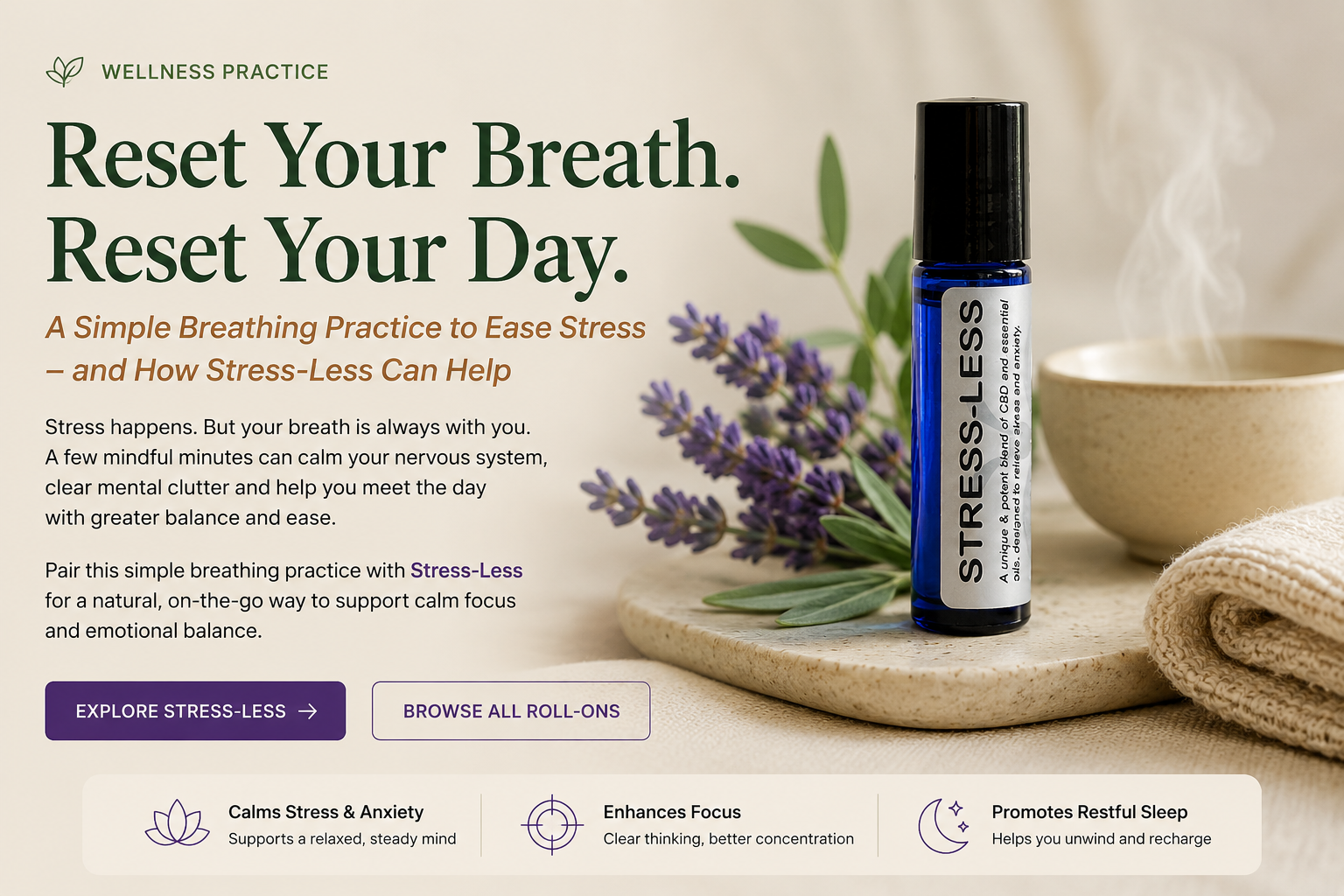
And that thinking brings us naturally to Stress-Less™.
Stress-Less™: CBD Designed for a Moment of Calm
We created Stress-Less™ as a convenient CBD roll-on for those moments when life feels a little too demanding.
It combines full-spectrum hemp extract with lavender, bergamot and ylang ylang essential oils, together with linalool, a naturally occurring terpene associated particularly with lavender.
The idea isn’t that one ingredient suddenly “switches off” stress.
The idea is much simpler.
Pause. Apply. Notice. Breathe.
Apply Stress-Less using The Bee Well Way, to the hollow immediately behind each earlobe.
Then, rather than immediately returning to whatever was demanding your attention, take a moment.
Notice your shoulders.
Notice your jaw.
And most importantly, notice your breathing.
Has it become shallow?
Were you holding it?
Are you breathing faster than you realized?
Allow yourself several comfortable breaths and, if it feels natural, let the exhale become slightly longer.
Perhaps your body was telling you that you were stressed before your conscious mind had caught up.
Can Aroma Become a Cue to Pause and Breathe?
Our sense of smell has close connections with brain areas involved in memory and emotion.
That’s one reason a familiar aroma can instantly evoke a place, person or experience from years ago.
It also raises an interesting possibility for a regular stress-management practice.
When a familiar aroma is repeatedly associated with taking a moment to pause, become present and breathe more consciously, the scent itself can become part of that familiar experience.
Stress-Less combines the aromas of lavender, bergamot and ylang ylang with CBD in a small roll-on that can easily be kept nearby.
At your desk.
In a purse.
In a pocket.
Wherever stressful moments tend to find you.
The objective isn’t to create an elaborate routine.
It’s simply to create an opportunity to interrupt the automatic response.
Listen to What Your Breathing Is Telling You
Stress isn’t always announced by a racing mind or an overwhelming feeling of tension.
Sometimes it whispers.
A shoulder rises.
A jaw tightens.
A breath becomes shallow.
Or stops altogether for a few seconds.
Learning to notice these small changes won’t remove stress from your life.
But it may help you recognize stress earlier.
And breathing gives you something else as well:
A physiological process that normally happens automatically, yet remains available to conscious influence at any moment.
Your next breath was going to happen anyway.
Perhaps occasionally it’s worth noticing it.
Frequently Asked Questions
Can stress really change your breathing?
Yes. Stress activates physiological responses involving the autonomic nervous system, and breathing may become faster, shallower or more centered in the upper chest. These changes can occur automatically and may sometimes become noticeable before you consciously recognize that you’re feeling stressed.
Why do I hold my breath when I’m stressed or concentrating?
Intense concentration, anticipation and emotional stress can alter normal breathing patterns. Some people unconsciously pause or restrict their breathing while working at a screen, composing messages, reading or making difficult decisions. “Screen apnea” and “email apnea” are informal terms sometimes used to describe this behavior.
Can stress cause shallow breathing?
Stress can be accompanied by faster, shallower breathing and greater use of the upper chest. The body’s stress response prepares us for action even when the modern source of stress — such as a deadline or difficult conversation — doesn’t actually require physical exertion.
Can stress make you feel short of breath?
Stress and anxiety can be accompanied by changes in breathing that may create a sensation of breathlessness or difficulty taking a satisfying breath. However, shortness of breath has many possible causes. New, severe, persistent or unexplained breathing difficulties should be evaluated by an appropriate healthcare professional rather than assumed to be caused by stress.
Can changing your breathing help reduce everyday stress?
Research suggests that slow, comfortable breathing can influence autonomic nervous system activity and increase measures of vagally mediated heart rate variability. Many people also report feeling calmer following slow-breathing practices. Breathing techniques are best viewed as self-regulation tools rather than cures or treatments for stress or anxiety disorders.
Why does a longer exhale feel calming?
Breathing and heart rate are naturally connected. Slow breathing, including techniques involving a comfortable longer exhalation, can influence heart-rate variability and parasympathetic activity. The breathing shouldn’t be forced — a gentle, comfortable rhythm is more important than achieving a particular count.
What does the vagus nerve have to do with breathing?
The vagus nerve is a major component of the parasympathetic nervous system and helps regulate functions including heart rate. Slow breathing affects the relationship between respiration and cardiovascular rhythms, and research indicates that vagally mediated mechanisms contribute to some of the autonomic changes associated with slow breathing.
Can breathing exercises improve mental clarity?
There is emerging evidence that they may help under some circumstances. A 2025 randomized study found that a brief slow-paced breathing session with longer exhalation improved working-memory performance while temporarily reducing perceived stress. More research is needed, but the findings support the idea that becoming physiologically calmer may sometimes make focused thinking easier.
Why can’t I concentrate when I’m stressed?
Stress can place the body and brain into a state of heightened alertness in which attention becomes strongly attracted to whatever seems urgent. When multiple demands compete for attention, clear thinking and sustained concentration can become more difficult. Briefly interrupting that cycle with breath awareness or another calming practice may help restore a more settled state for focused attention.
Is CBD showing promise for stress and anxiety?
Yes. CBD is showing considerable promise in research exploring anxiety and related areas, although the clinical evidence is still developing. A 2024 systematic review and meta-analysis reported a significant overall effect on anxiety across the studies included, while also emphasizing the relatively small clinical sample and need for further research.
Can CBD be combined with breathing and relaxation practices?
CBD can form part of a broader personal wellness practice alongside approaches such as mindful breathing, movement, adequate sleep and relaxation. At Bee Well, we prefer to think in terms of complementary practices rather than expecting any single ingredient or technique to do everything.
This article is provided for general educational purposes and is not intended to diagnose, treat, cure or prevent any disease. Persistent breathing difficulties, severe anxiety or other concerning symptoms should be discussed with an appropriate healthcare professional.
“`
